Skip to main content
Skip to footer
Skip to main content
Skip to footer

Becoming a parent can be one of life’s most rewarding experiences, but it is also a uniquely vulnerable time for mental health. In this blog, the Maternal Mental Health Alliance explores why perinatal mental health support in the workplace matters, and how employers can help create safer, more supportive environments for parents and carers.
The stage of life when you begin thinking about becoming a parent, whether that involves pregnancy, adoption, surrogacy, or other routes, is rarely straightforward. For many, the journey may include uncertainty, loss, or unexpected turns, and each path deserves recognition and compassion.
It is a uniquely vulnerable time, one that is known to significantly increase the risk of mental health difficulties. Many clinicians refer to this phase as the ‘perinatal period’. A time when emotional, psychological, hormonal, and social pressures combine in ways that can heighten the risk of mental health problems.
At least 1 in 4 women and birthing people experience a diagnosable perinatal mental health problem during pregnancy or after birth. We also know that dads, partners, and non-birthing parents can be deeply affected too, and their mental health often goes unrecognised and unsupported.
Perinatal mental health at work
More than half of people experiencing perinatal mental health difficulties hide their symptoms, meaning many return to work with their illness still unrecognised and untreated. And for some, the challenges begin long before birth. Fertility journeys, for example. including fertility treatment, pregnancy loss, or the uncertainty of trying to conceive, can bring enormous emotional strain.
Mental health problems that begin in pregnancy, such as anxiety, depression, trauma responses, or hyperemesis-related distress, can also make it harder to manage workload, maintain concentration, or meet expectations. Yet these struggles often go unseen, leaving people to cope privately while trying to continue working as normal.
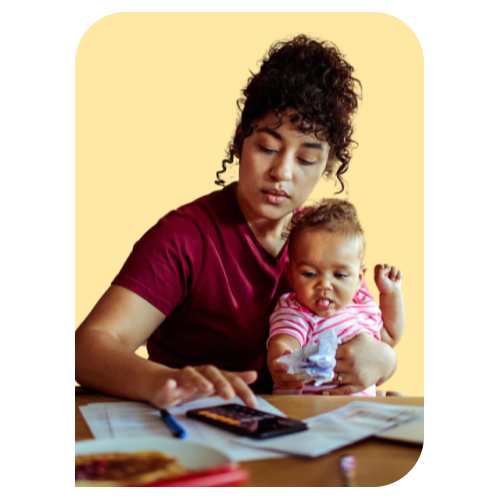
Returning to work as a new parent adds another layer of difficulty. Day-to-day logistics, financial pressures, parental guilt about leaving a baby in childcare, or simply not feeling emotionally ready can all contribute to significant strain. For those who are already struggling, this transition can feel overwhelming. In some cases, the pressure is so great that returning to work is delayed or not possible at all.
Sadly we know that two in five working parents say they do not feel comfortable talking to anyone at work about their mental health*. And for those open to sharing, their colleagues or peers would be their go-to people to talk to, rather than line managers. This gap is unacceptable. We must empower workplaces to support parents with and normalise conversations around perinatal mental health.
A proud partner of Family Friendly Workplaces
MMHA is proud to be an advocacy partner for the Family Friendly Workplaces (FFW) certification programme. Through this partnership, employers who want to take a deeper, more informed approach to perinatal mental health can work with us to better understand and respond to the needs of their workforce.
This focus is a vital part of what it means to be truly family friendly. Without specific attention to the mental health of parents and carers, their needs risk being overlooked within a broader mental health agenda that does not fully reflect the scale or nature of the challenges they face.
Support in the workplace is urgently needed
At the Maternal Mental Health Alliance, we’re dedicated to ensuring all families impacted by perinatal mental health problems have access to the right type of mental health care, at the right time, without discrimination. That means in the workplace as well as at home.
We created The Parent Gap as a response to the question – “Why isn’t perinatal mental health spoken about in the workplace?”. Despite (much needed) progress in conversations and provisions at work for broader mental health, physical health conditions impacting women, equal parenting and family friendly working practices, perinatal mental health is still largely overlooked:
- Missing from family policies.
- Missing from mental health policies.
- Missing from Health & Safety assessments.
- Missing from Mental Health First Aider training.
- Missing from wellbeing resources and Employee Assistance Programmes.
You can take easy action by joining us as a partner at The Parent Gap. Our free and paid for resources equip you to raise awareness, assess for risk, manage difficult mental health conversations and signpost to perinatal mental health support at every opportunity.
Download our Symptom Checker
Knowing the symptoms of perinatal mental illness may allow you to recognise signs in yourself, or in colleagues that may indicate that they require some support. Download our Perinatal Mental Health Symptom Checker, and stick it up in kitchens, breakout spaces or toilets in your workplace. This is a small but important step towards raising awareness.
Let’s close the gap and support parents at work
Our ambition for The Parent Gap is to ensure that parent and carers thrive professionally and personally during their journey into and through parenthood, in a supportive and psychologically safe workplace.
By incorporating perinatal mental health care into internal policies and having supportive conversations at return-to-work meetings and as part of day-to-day life in the workplace, you are providing vital emotional support in the workplace which we know improves working relationships, builds staff satisfaction and increases retention. Let’s close the gap, together.
*wholeSum, survey of 488 parents (95% mothers) of under 3s, May 2024
Find out how family-friendly your workplace is – take the Self-Assessment.